Network Engine 1.0.4 · now supporting VyOS

Deploy-and-gohardware for every NVA

Network Engine turns network virtual appliances into deploy-and-go hardware — the flexibility of an NVA with the ease of an appliance. Its registry-driven framework gives every supported NVA — F5 BIG-IP VE, F5 Distributed Cloud Customer Edge, Arista CloudEOS, Palo Alto PAN-OS, and VyOS (validated from 1.5.0, minimum 1.5 LTS) — the same one-command deploy path.
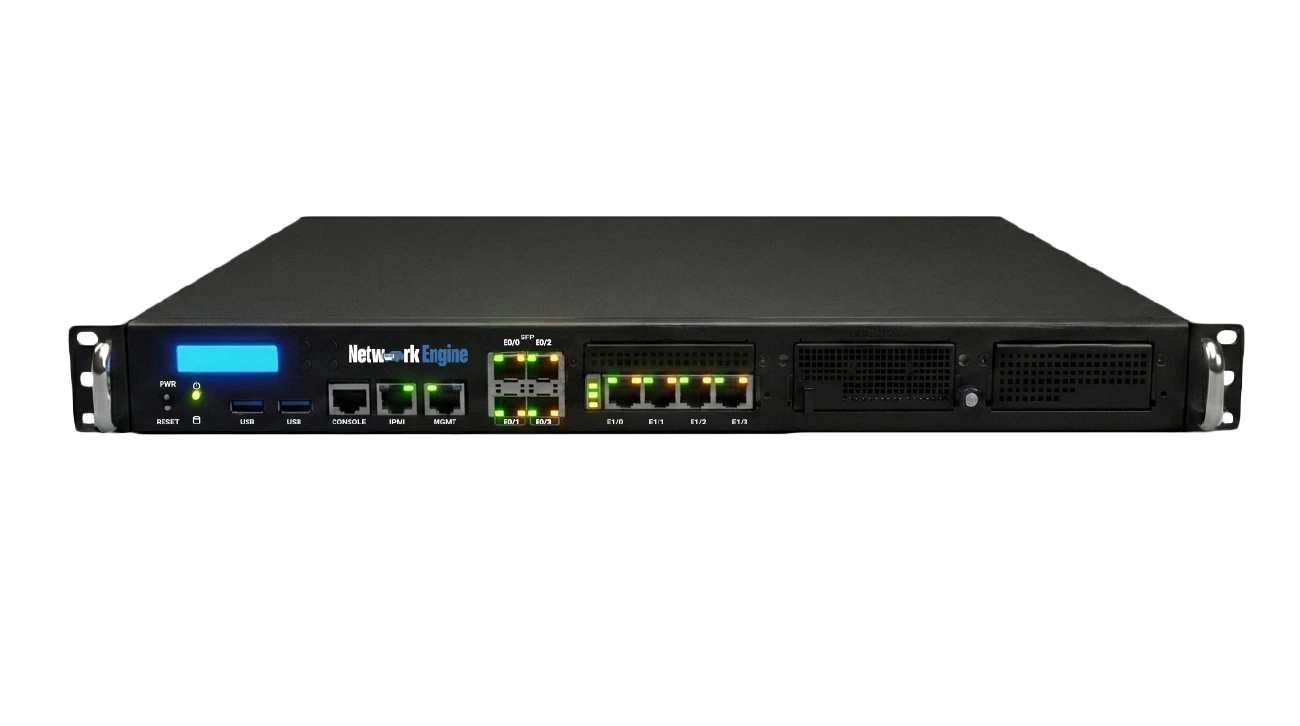
Network Engine 1U network virtualization appliance
1.0.4
current release
25GbE
ready networking
1 command
to deploy an NVA
minutes
to first-boot reachable
Supported NVAs on Network Engine 1.0.4 — same deploy path for every one

F5 BIG-IP VE / F5 XC CE / Arista CloudEOS / Palo Alto PAN-OS / VyOS
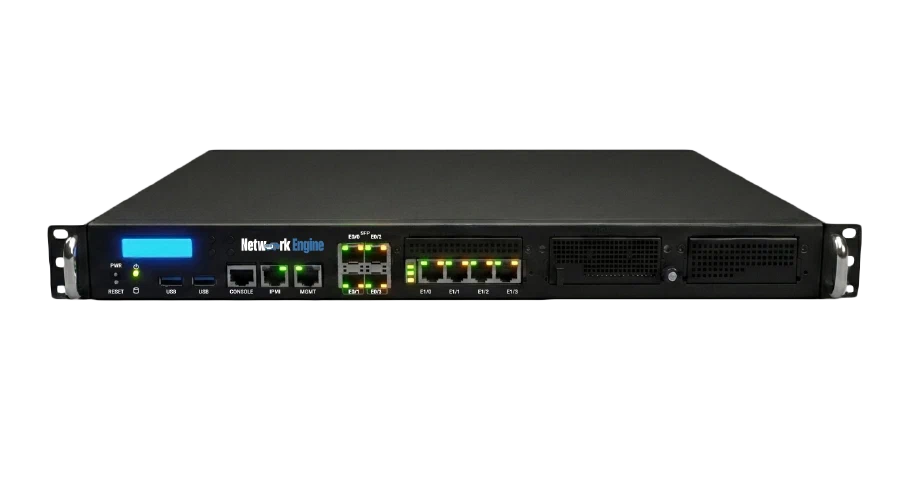
Network Engine 1U appliance — front panel
Network Engine · 1U in production
The product

Purpose-built hardware for NVAs

A 1U appliance with a registry-driven deploy framework built in — every supported NVA follows the same deploy → status → remove grammar. Cloud-init seeds hostname, SSH, and static management addressing on first boot when a management NIC is present. DNS, NTP, and guest VLANs stay day-2 operator work, same as any appliance.

  • One-command deploy per NVA
  • 1U hardware, 25GbE-ready networking
  • virtio-multiqueue dataplane tuning
  • Airgapped-friendly — SCP once, reuse the image
The challenge

Your hypervisor isn't race ready

Generic virtualization wasn't designed for line-rate packet processing. The result is a security stack that loses momentum exactly where it can't afford to.

Latency & packet drops

NVAs choke on latency, CPU contention, and packet drops the moment traffic spikes.

Stalled security stacks

Security stacks lose momentum and stall — throughput collapses under contention.

Hardware you don't own

Your team doesn't own the hypervisor hardware, so the bottleneck is never yours to fix.

Why Network Engine

The flexibility of an NVA.
The ease of an appliance.

Every supported NVA — including VyOS (validated from 1.5.0, minimum VyOS 1.5 LTS) — deploys through the same registry-driven path. Cloud-init handles day-0 config; DNS, NTP, and guest VLANs stay day-2, the normal operator work of dialing in a network appliance, not a gap in the integration.

Registry-driven deploy path Cloud-init day-0 config 1U · 25GbE-ready
Benchmark your NVAs free
netengine · nva deploy
$ network-engine nva vyos deploy
> collecting mgmt IP, hostname, DNS, credentials…
> seeding cloud-init: hostname, SSH, static mgmt IP
> proceed? [y/N] y
statusrunning
nvavyos · 1.5 LTS
host1U · 25GbE-ready
The platform

Engineered for every NVA

A registry-driven appliance framework, pre-configured. Same deploy path for every supported NVA — no manual kernel work.

Registry-driven deploy framework

Every supported NVA follows the same deploy → status → remove grammar.

One-command deploy

A wizard collects mgmt IP, hostname, DNS, and credentials up front, then does it.

Cloud-init day-0 config

Hostname, SSH, and static mgmt addressing seed on first boot when a mgmt NIC is present.

1U hardware, 25GbE-ready

Intel Xeon, 22 cores / 44 threads, 128GB RAM, 4×25Gb SFP28 + 4×10Gb copper.

virtio-multiqueue dataplane

Paravirtualized tuning out of the box, so supported NVAs actually push those packets.

Airgapped-friendly images

SCP the image once, reuse it across many instances — no repeated downloads.

Book your architecture session
Shipped, not roadmap

What's in 1.0.4 today

5 NVAs
Supported on the same deploy path
25 GbE
Ready networking, 1U appliance
1 host
Per-host licensing, no core math
30 min
Architecture session, free

AI-accelerated engineering. Network Engine is developed and continuously tuned with an AI-in-the-loop workflow — so the platform keeps pace with the threats and traffic of 2026, not last decade's assumptions.

Stop paying the virtualization tax

We'll benchmark your current NVAs and show exactly where Network Engine unlocks headroom — free of charge.

FAQ

Questions, answered

What makes this different from generic KVM hosts?
Network Engine ships with a registry-driven deploy framework, cloud-init day-0 config, and virtio-multiqueue dataplane tuning — every supported NVA follows the same deploy → status → remove path, no manual tuning.
Which NVAs are supported today?
Network Engine 1.0.4 (cut August 20, 2026) supports F5 BIG-IP VE, F5 Distributed Cloud Customer Edge, Arista CloudEOS, Palo Alto PAN-OS, and VyOS — validated from VyOS 1.5.0, with VyOS 1.5 LTS as the minimum supported version.
Is licensing per core or per host?
Per host. No surprise costs if you scale cores for burst workloads.
What does the architecture session include?
Traffic-pattern review, bottleneck analysis, and a tailored migration plan — free of charge.
Still have questions? Talk to a Solutions Architect →
Ready to get started?

See Network Engine live

Book a 30-minute session with a Solutions Architect. We'll benchmark your current NVAs and show exactly where Network Engine unlocks headroom.

Traffic review + migration plan, free of charge.